


The inciting incident
Come April 2026, adult educators (AEs) who wish to conduct SkillsFuture (SSG)-supported courses must be on the National Adult Educator Registry, which is under the Training and Adult Educator Professional Pathway (TAEPP) that is being developed by the Institute for Adult Learning (IAL).
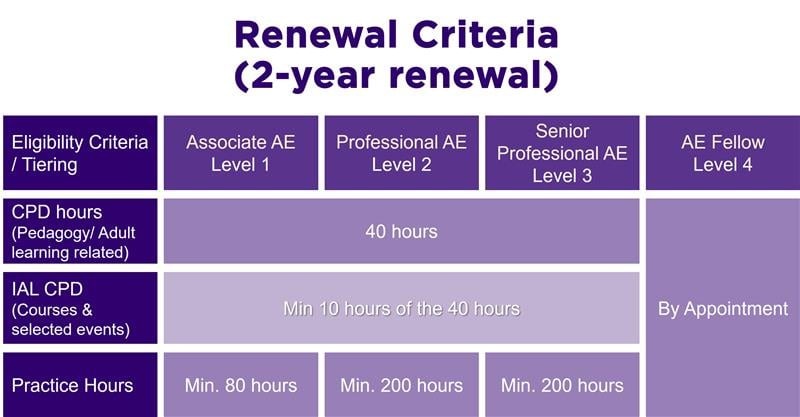
To be on the registry, adult educators must complete at least 40 Continuing Professional Development (CPD) hours (at least 10 of which must come from IAL) and 80 practice hours every two years. If you’d like to be a Professional Adult Educator or above, then you’ll need to complete at least 80 practice hours.
This will impact trainers, facilitators, coaches, and course developers.
Understandably, there’s a lot of anxiety about it. Not least because the Straits Times article about it (“New SkillsFuture requirements from April 2026 to mandate regular training for adult educators”) repeatedly uses words like:
- mandate
- mandatory
- stay registered
- required
All of these words point to one key idea – adult educators are going to be forced to learn.
But let’s break down the messaging. There are actually two key ideas behind it:
- being forced
- to learn
Adult educators are in the field of andragogy. So what does adult learning – andragogy – have to say about forcing adults educators to learn?

The good intentions behind the mandate
I’m going to say it right here – the intentions behind the mandate are good. Getting adult educators to learn is good. Upskilling the people who upskill others is good.
And when we look at what the mandate aims to achieve, they’re all desirable outcomes:
- Raising the quality of training
- Ensuring adult educators continue to upgrade
- Ensuring adult educators continue to keep up with industry requirements
- Ensuring adult educators keep up with new training methods
- Professionalise the training and adult education (TAE) sector
- Implicitly, ensuring that adult educators walk the talk of lifelong learning
In principle, they’re great goals. I want to be taught by someone who still reads, learns, and grows. I don’t want to be taught by someone who, in 2025, still doesn’t know how to use Zoom.
When IAL did a TAEPP engagement session a week ago, there was an online participant who clearly did not know how to use Zoom – said participant was flashing a naked body on camera and leaving the microphone on for all and sundry to listen to some sort of rant online.
That, to me, very clearly highlighted the need for this sort of professionalisation. If an adult educator doesn’t even know how to behave as an online learner, I can hardly trust this person’s skills in training and adult education.
So as much as I feel that is ironic to tell adult educators to learn… the briefing was a stark example of why some adult educators need it.

What andragogy says
Let’s put on our andragogy glasses and revisit the six key assumptions of adult learning (Knowles et al., 2015)
- The need to know: Adults need to know why they’re learning something.
- The role of experience: Adults bring prior experience that shapes new learning.
- Self-concept: Adults want to be self-directed learners.
- Readiness to learn: Adults are ready to learn things relevant to their lives.
- Problem orientation (orientation to learning): Adults prefer problem-solving to content absorption.
- Intrinsic motivation to learn: Adults are driven more by internal motivation than external mandates.
How do “mandates” which “require” “mandatory” CPD hours to “stay registered” fit with andragogy principles?
Spoiler: not very well.

The fear of compliance
Obligation kills engagement.
When learning feels like coercion, it loses its spark (Merriam & Bierema, 2013). What’s worse is that compliance-driven CPD leads to disengaged educators (Kennedy, 2014), which then results in said AEs going through the motions without changing practice. And mandatory workshops often end up being symbolic – fulfilling checkboxes rather than stimulating growth (Caffarella & Daffron, 2013).
And therein is the fear.
The fear is that we won’t be able to meet the 40 CPD hours and lose our registration.
The fear is that we’ll have to attend boring courses just to fulfill the 40 CPD hours.
The fear is that we’re already so stretched with our work and other social obligations, that pulling out another 40 hours is going to exhaust us.
I’m naming this fear so that we know what we’re up against, to know what exactly the bugbear is.

But actually… it’s easier than that
The situation isn’t all that bleak.
Firstly, CPD hours doesn’t just mean attending a course. According to Mr Desmond Lee and the TAEPP, CPD hours refers to:
- structured training
- workshops
- conferences
- workplace learning
It’s just that the options haven’t been clearly laid out yet. Yes, more planning and organisation could have been done before announcing this news, but I’d rather know earlier rather than later. And it’s not that they’re not planning it now either.
Workplace learning is a very broad category too.
Secondly, SkillsFuture subsidies can be used for SSG-supported programmes.
I also found out recently that AEs who are also NTUC union members can utilise NTUC/ESU’s Union Training Assistance Programme (UTAP) for professional development courses within the UTAP directory. NTUC membership fees are $9 a month, $18 in December. This is not a sponsored post, nor have I looked up the UTAP courses. But it’s pretty good deal that can defray costs.
Thirdly, 40 hours is basically a 5-day course (assuming one day is 8 hours). Just going for a full day course will net you 8 hours of training. So going for 2.5 days of training a year will fulfill this criteria. I myself have gone for 3 full-day courses in the first half of this year alone, although sadly this will not count towards by CPD hours because it’s before 2025 April.
If you’re a good AE, you’re definitely going for more than 2.5 hours of CPD training a year.
So in terms of options, money, and time, it’s quite do-able.

It’s about trust
To me, the issue has really been about the messaging – the words used.
“Mandate”, “mandatory”, “required”, “stay registered” – all these signal that “we don’t trust you to grow on your own.”
But when you look at the requirements, they’re probably already what you’re doing, and it’s more a matter of more admin work (ie, reporting all these hours). I hate admin work too, so I’m not terribly excited. But nevertheless, it’s probably an additional 1-2 hours per year to do the admin work.
So it’s more of misaligned messaging than actually forcing you to do it.
If you’re a good adult educator, you’re curious. Perhaps the most curious person in the room. Perhaps you’re a cat.
You’re already doing all the CPD hours.

How about the training hours?
I don’t really feel that 80/200 training hours a year is very onerous. It works out to 40/100 hours a year. That, in turn, works out to 5/12.5 full days of training (assuming one full day is 8 hours)
If you’re a practicing AE, you’ll probably be teaching that many SSG hours a year (or more). If you’re not teaching that many SSG hours a year, this framework doesn’t really benefit you (because it’s specifically aimed at SSG courses).
I know that if you teach super specialised courses, you may teach less than 5 full days a year. But if you’re only teaching that super specialised course, it is unlikely to be an SSG course, so this probably doesn’t benefit you.
If it does – during IAL’s engagement session, there were suggestions to write in and discuss it with them. So the answer isn’t a no. The answer is “let’s discuss”.

What could we expand for the Training and Adult Educator Professional Pathway (TAEPP)?
This is a wish list that’s entirely based on my needs, and some of the information has already been echoed in the information session.
To me, I hope that CPD hours can include:
- mentorship hours (there is a an AE Mentorship programme in place at IAL already,
- OJT hours (this is not explicitly called out)
- reading related books (because I read a lot, and isn’t this CPD?)
- doing other tertiary programmes like a diploma or a Master’s (because I am already learning by attending that structured programme)
- contributing content and research (like writing this article)
Perhaps that’s already in the pipeline, and we’re just awaiting more detailed instructions from the government.
As for training hours – the engagement session shared that the following counts:
- curriculum development (DDDLP thanks you)
- learning consultancy (because that is also training)
So I think all’s good!

CPD should feel like levelling up
I like games so this should come as no surprise.
Right now, I’m appreciative that we’ve been informed early about the CPD and training hour requirements. This gives us time to act and to plan, and to be efficient.
For me, I hope that CPD will feel like levelling up in game – gaining experience and new powers and abilities, like:
- gaining new training techniques (gamification!) to better serve learners
- testing out new theories to reflect and iterate
- unlocking new teaching achievements or XP (I’m a sucker for badges)
So to make this very clear, my stand is that I support the new CPD requirements. I feel all good adult educators are doing it already. And the benefits outweigh the (admin) cons (although again, not a fan of admin).
Ultimately, the goal isn’t to force us to learn (it’s just the messaging that’s not great).
The goal is make us better educators.
Educators who are lifelong learners.

You might also want to read:
References
Knowles, M. S., Holton, E. F., & Swanson, R. A. (2015). The Adult Learner (8th ed.). Routledge.
Merriam, S. B., & Bierema, L. L. (2013). Adult Learning: Linking Theory and Practice. Jossey-Bass.
Caffarella, R. S., & Daffron, S. R. (2013). Planning Programs for Adult Learners. Jossey-Bass.


Leave a Reply