
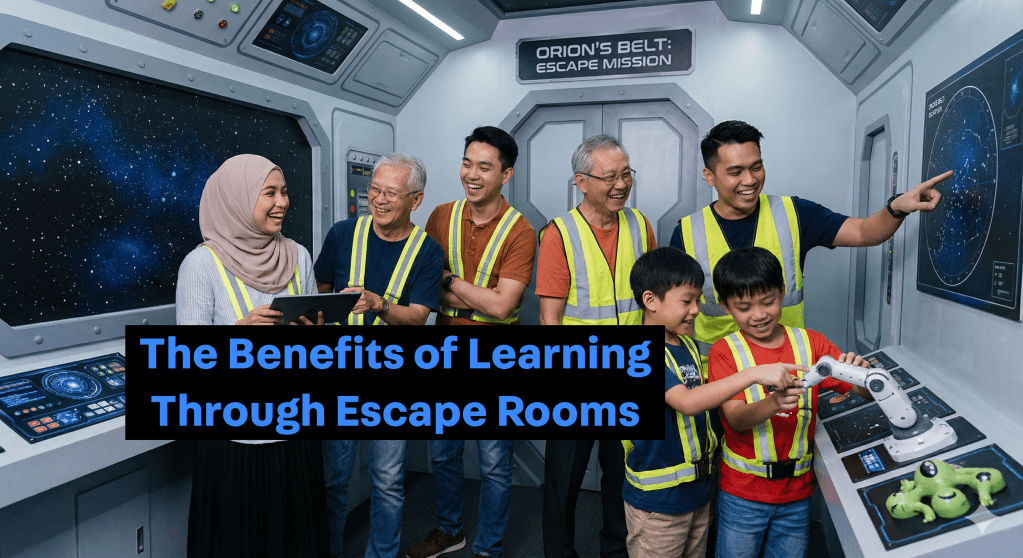
An alien invasion of student engagement
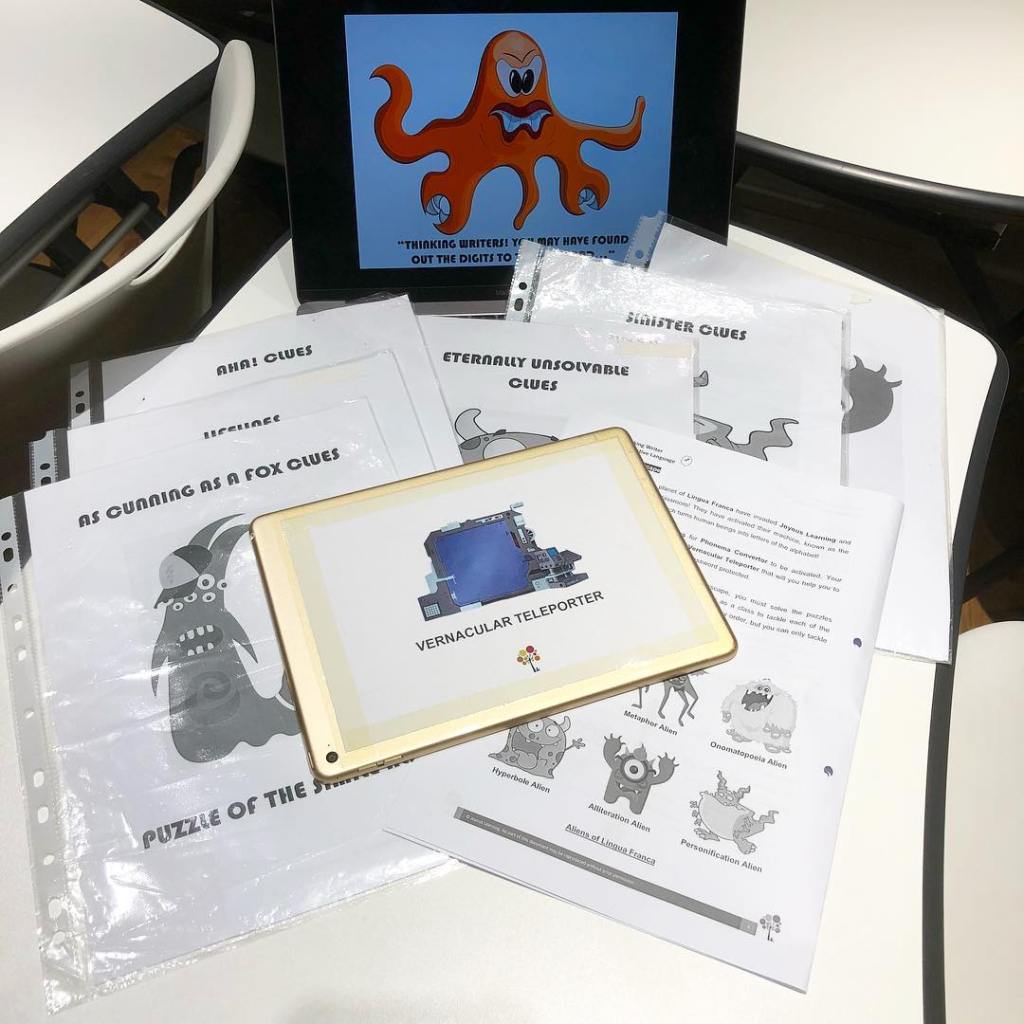
My very first escape room arose from writing a vocabulary lesson about figurative language. It was about the usual lists of phrases, getting students to use them in different sentences, a very standard English lesson.
If you’re not a native English speaker, figurative language is like an alien language to you. I mean look at how Drax from Guardians of the Galaxy is so literal. Figurative language is weird, and it is alien.
And that was the seed for my first escape room lesson.
What if aliens of figurative language invaded and kidnapped the teacher? To save their teacher, the students would have to rise to the challenge of being heroes and solving all the figurative language puzzles.
It turned out to be a surprising hit. Nobody expected to come to class and be playing an educational escape room, running helter skelter trying to solve puzzles, all while a timer was playing in the background.
When I took a step back to think about my first escape room lesson, it became obvious to me why it was exciting.
The learners were the heroes of the story. Learning was much more than just about cramming more words into their vocabulary bank. Learning was about saving their teacher and defeating dastardly aliens.
Most importantly, it was fun. Fun makes the learning sticky.
What exactly is an educational escape room?
I’ll use the terms educational escape rooms and escape room lessons interchangeably.
An escape room is a live-action, team-based game where players solve puzzles under time pressure to achieve a goal (Nicholson, 2018).
An escape room lesson is a a lesson where the learning materials have been transformed into puzzles. It is delivered as live-action, team-based game where learners solve puzzles under time pressure as a gamified assessment, which is facilitated by an educator.
Educational escape rooms don’t require stagecraft – meaning you don’t have to build all those tunnels and secret hatches into the location. That would not be feasible.
What you do have are learning materials, props, and puzzles. The puzzles are usually of an academic nature (think word searches and matching activities) but with a bit more time, you can create props that allow for more tactile interactions.
The key features of escape room lessons are:
- team-based problem solving
- narrative context
- time pressure
- gameplay sequence
- active learning strategies
- clue systems
Benefits of escape room lessons
Plenty of research has shown that across different disciplines (STEM, languages, social sciences) and across different learners (at-risk or special education), educational escape rooms:
- promote active learning
- promote engagement
- promote motivation
- improve student engagement
- improve learning outcomes
- create flow
- improve classroom climate
(González-Yubero et al., 2023; Makri et al., 2021; Manzano-León et al., 2021; Roig et al., 2023; Veldkamp et al., 2020).

Educational escape rooms are play in action
Escape room lessons are basically play – which enhances creativity, reduces stress, and elevates wellbeing.
It’s a form of structured play which fulfills the three needs of Self-Determination theory – autonomy (you make choices), competence (you solve puzzles and achieve goals), and relatedness (you work in a team).
It also fulfills the PERMA model of wellbeing – positive emotions (the joy and excitement of play), Engagement (being focused on solving it within a time limit), Relationships (you work in a team), Meaning (having a purpose to fulfill), and Accomplishment (solving the puzzles).
In my very first example – making the learners the heroes of the story gave them autonomy and competence. In an education system where learners don’t get much autonomy – I believe this was the first time they had significant, meaningful autonomy in their learning.

Escape room lessons are worth the setup
Educational escape rooms take time to develop and setup. The time and effort investment is significant.
But they’re not as expensive as you may think they are.
And more importantly, they’re research-based forms of experiential learning.
Escape room lessons can be reused, so don’t think of them as one and done deals.
It’s your way of escape dull, disconnected learning.
And if you’re interested in creating your own escape room curriculum – ping me.

References
González-Yubero, S., Mauri, M., Cardoso, M. J., & Palomera, R. (2023). Learning through challenges and enigmas: Educational escape room as a predictive experience of motivation in university students. Sustainability, 15(17), 13001. https://doi.org/10.3390/su151713001
Makri, A., Vlachopoulos, D., & Martina, R. A. (2021). Digital escape rooms as innovative pedagogical tools in education: A systematic literature review. Sustainability, 13(8), 4587. https://doi.org/10.3390/su13084587
Manzano-León, A., Rodríguez-Ferrer, J. M., Aguilar-Parra, J. M., Martínez-Martínez, A. M., Luque-de-la-Rosa, A., Salguero-García, D., & Fernández-Campoy, J. M. (2021). Escape rooms as a learning strategy for special education master’s degree students. International Journal of Environmental Research and Public Health, 18(14), 7304. https://doi.org/10.3390/ijerph18147304
Nicholson, S. (2018). Creating engaging escape rooms for the classroom. Childhood Education 94(1). 44-49. https://doi.org/10.1080/00094056.2018.1420363
Roig, P. J., Alcaraz, S., Gilly, K., Bernad, C., & Juiz, C. (2023, June 14). Escape rooms in educational environments. Encyclopedia. https://encyclopedia.pub/entry/45576
Veldkamp, A., van de Grint, L., Knippels, M. P. J., & van Joolingen, W. R. (2020). Escape education: A systematic review on escape rooms in education. Educational Research Review, 31, 100364. https://doi.org/10.1016/j.edurev.2020.100364


 Fun to be Smart
Leave a comment