

Gamified learning is efficient learning
If you’re an educator, gamifying your lessons feels like adding extra work to your already tremendous workload. If you’re a curriculum writer, gamifying your course material feels like adding more pages to a document that might not even be appreciated.
So why add games to your lessons?
Because it enhances the retention of the material and improves the learning.
It’s a purely practical perspective – which also happens to be pretty fun to do.
Benefits of gamification in lessons
Gamifying learning is primarily to increase fun for your students, because fun is what improves learning. If your learners are already having fun, then in a way, you’re already gamifying it.
If you’re able to craft a lesson with a game designer mindset, then you’re also enhancing the fun and learning in your classes.
But how does fun increase learning? It creates joy, interest, curiosity, humour, and positive emotions. Here’s what the research says:
- Joy and curiosity broadens a person’s perspectives, allowing them to make better connections between disparate ideas, according to the Broaden-and-Build Theory (Frederickson, 2001)
- Joy and interest increases intrinsic motivation, which results in better persistence, deeper learning, and higher academic achievement (Ryan & Deci, 1985)
- Humour improves retention and attention (Ziv, 1988)
- Curiosity is a trigger for dopamine which ultimately improves learning and memory (Gruber et al., 2014)
- When a classroom has positive emotions, learners can better focus, regulate themselves, and enjoy greater depth of learning (Immordino-Yang & Damasio, 2007)
So when you implement these activities – remember what your ultimate objective is. To create all these positive emotions, which will enhance your learning.
Learning Game #1: Scavenger hunt (with dummy items)
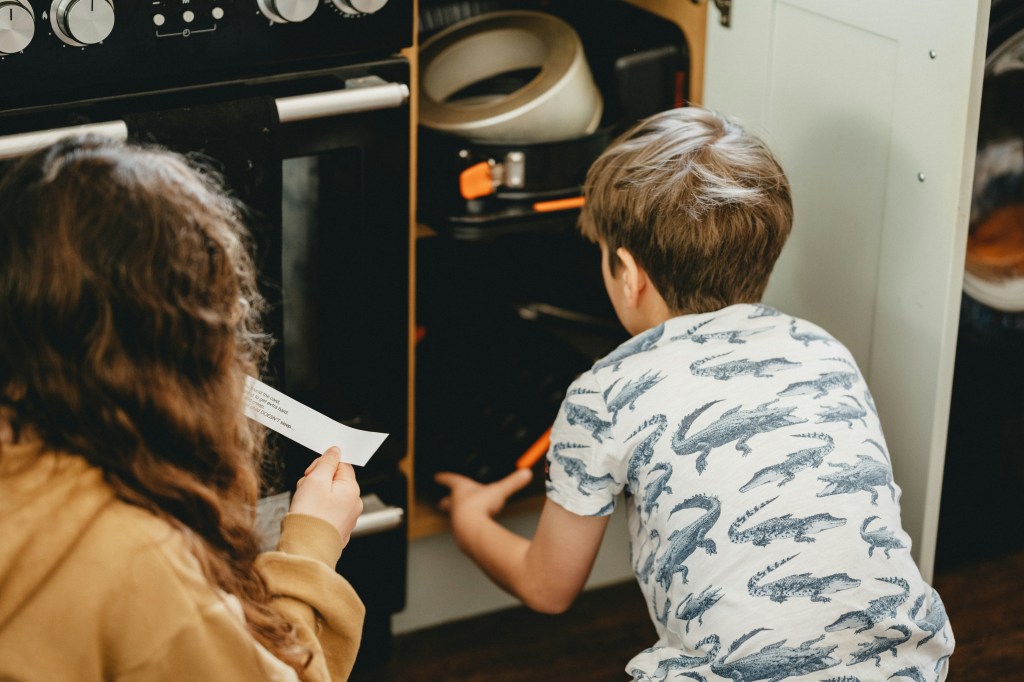
Scavenger hunts are useful not just because they get your learners to stand up and walk around (which increases blood circulation and adds a tactile element to their learning). They’re useful because they invite curiosity (searching for things) and expand awareness (looking around the class area for items).
The simplest scavenger hunt entails you hiding things in a classroom for students to find later. This works with young and adult learners (surprise!) and I’ve found that adult learners can be very competitive (thus creating motivation) when it comes to this. Here are my best tips for this:
- Hiding paper slips/cards with concepts/ideas is the most cost-effective
- You can either print out these out on paper and cut them up, or write them out yourself (depending on the amount of work you have)
- I usually leave a stack of paper slips at one place, so that learners can help each other out and say “oh that concept is over there”
- I usually take photos of where I have left the stacks (because you might forget)
- You don’t have to hide it during class time – you can actually hide it while they are doing another written activity that demands their focus. Trust me, the learners don’t notice what you’re doing when they are writing things down.
- How to elevate your scavenger hunt: Add dummy items. This means add concepts or ideas that are the wrong answer/not part of what you are teaching. The look on learners’ faces is priceless when they discover that there are “too many” items or that some of the items are decoys. This also helps them be more alert and mindful of the concepts they are searching for during the scavenger hunt.

Learning Game #2: Charades
Silent charades – meaning that the participant has to act out the behaviour – helps to enhance creativity (expressing ideas in a nonverbal way) and broaden perspectives (when the guesser has to figure out what it means).
For obvious reasons, a lot of our learning is text-based, meaning we use visuals and audio. But adding that kinaesthetic element helps learners “touch” the information in additional ways, creating spaced repetition.
I find that adults take to it with oddly much more gusto than kids.
Here are my tips for charades:
- Break down the concepts or ideas into either terms or phrases, then write them down on slips of paper (or print it)
- Divide the class into teams (preferably 2), and each team has to send a performer to act out the charade
- Whichever team guesses what the performer is trying to depict, wins a point
- Tabulate the points at the end
- Variations include: letting each team send a performer (so there are two performers at once), having teams separately watch a performer from their own group act out the concept/idea
- How to elevate your charades: This requires multi-word concepts or ideas. What you can do is to have at least two performers – then each performer must act out part of the concept/idea. The team that gets the whole phrase correct, wins. So for example, the concept might be “guess-and-check”. The first performer might get “guess” while the second performer gets “and-check”. Neither performer knows what the other perform is doing, nor do they know whether they are the first or last word. It might be a little chaotic, but it’s a big twist on regular charades!

Learning Game #3: Reverse Answers
This works only if all the participants are confident or agreeable, and it also assumes a certain level of competence and ability to deal with large sensory inputs.
Select a participant and have him/her face the audience. Behind the participant, show a particular concept to the audience (which the participant cannot see). The audience must then shout out explanations or examples (but not the concept itself) for the participant to guess.
This has been useful in helping students learn their multiplication tables. I have a student face the class, and then flash a number behind them (like 60) (obviously, don’t use prime numbers). The class shouts out equations (5 x 12! 6 x 10!) for the student to guess the number behind them.
My tips for doing this are:
- Create simple slides that have the concept you want the participant to guess (or large paper printouts).
- Let participants volunteer to come up and be a guesser (don’t assign participants, as they have different levels of confidence).
- To manage noise, have the audience raise their hands when they want to say something, and let the guesser choose which audience he/she wants to hear from.
- How to elevate your reverse answers: Divide the class into teams, and assign each one a particular topic. Have them create the concepts that the other team has to guess. Then the team that created the concepts has to shout out the explanations for the other team to guess. For example, let’s say you are teaching two wellbeing theories, PERMA and SDT. Team 1 creates slides based on PERMA, while Team 2 creates slides on SDT. Then Team 1 has to shout out the explanations for PERMA for Team 2 to guess, while Team 2 has to shout out explanations for SDT for Team 1 to guess.
Learning Game #4: Gallery Style Fill-In-The-Blanks
You know what cloze passages are – so this is a gap fill exercise. There’s a passage or a list of statements, with blanks that the learners can fill in.
As a form of scaffolding, you can have galleries on the walls which contain the answer. Basically, you can have the answers to the blanks that are written in the form of an explanation or another text, that are printed out to be on the walls.
This maintains an element of writing and academia, while still creating a kinaesthetic environment and giving learners a sense of exploration (which then creates curiosity).
My best tips for this is:
- Make the answers non-obvious – ie, the jargon or technical terms for the topic you want to cover.
- To scaffold this, you can either bold the answers on the gallery text, or you can add the question number to the answers on the gallery text.
- Putting up the galleries before class and strongly hinting that they will be used, will encourage learners to read them (of course, don’t tell them what it’s for so they’ll read everything).
- How to elevate your gallery style fill-in-the-blanks: Have different worksheets prepared, which have the same answers but in a different order. The same answers should have the same number. This will create a little chaos at the beginning when they discover they have different worksheets, and it will prompt them to explore more rather than relying on their classmates for the answers.

Bonus: Elevate All Your Games With A Shared Universe
When I was designing bonus activities for a high-level (gifted education) English course, I created a shared universe. Basically, each activity was framed as a detective asking for help.
As the weeks went on, I added more drama. The detective got a girlfriend in one puzzle. The detective had a recurring nemesis in several puzzles. The recurring nemesis gathered all the previous villains for the penultimate puzzle. And in the final puzzle for the year, the detective’s girlfriend got kidnapped by the villain and solving the puzzle would save her. Anyway they got married in the end (had to pay it off somehow, right?).
It was quite the hit. And because I had built in a narrative and slowly made the learners care about this fictional character, they looked forward to the activity each week and had emotional investment in the character.
So creating a shared universe (taking a leaf from Marvel here) helps to connect all your activities together!
Creating Games Isn’t Difficult
Creating learning games isn’t costly or difficult. It takes a bit more time, yes, but doesn’t everything good in life take up more time?
Creating joy, curiosity, humour and interest improves retention. A fun lesson is a good lesson when the learners remember it for a long time thereafter.
Most importantly – you, the curriculum writer (or teacher), need to have fun with it. It must be fun for you.
It must be fun for you to see:
- the joy on learners’ faces when they’re playing
- the a-ha moments when the leaners figure it out
- that slightly stressed determined look that learners have when you know they are working something out
- the engagement and emotional investment that the learners have
Because learning should be fun for everyone – including the educators.
You might also want to read:
- Fun isn’t frivolous – it’s the secret sauce of great learning design
- The secret parallel between lessons and games: writing lessons like a game designer
References
Deci, E. L., & Ryan, R. M. (1985). Intrinsic Motivation and Self-Determination in Human Behavior. Springer. https://doi.org/10.1007/978-1-4899-2271-7
Fredrickson, B. L. (2001). The role of positive emotions in positive psychology: The broaden-and-build theory of positive emotions. American Psychologist, 56(3), 218–226. https://doi.org/10.1037//0003-066x.56.3.218
Gruber, M. J., Gelman, B. D., & Ranganath, C. (2014). States of curiosity modulate hippocampus-dependent learning via the dopaminergic circuit. Neuron, 84(2), 486–496. https://doi.org/10.1016/j.neuron.2014.08.060
Immordino-Yang, M. H., & Damasio, A. (2007). We feel, therefore we learn: The relevance of affective and social neuroscience to education. Mind, Brain, and Education, 1(1), 3–10. https://doi.org/10.1111/j.1751-228X.2007.00004.x
Ziv, A. (1988). Teaching and learning with humor: Experiment and replication. Journal of Experimental Education, 57(1), 5–15. http://www.jstor.org/stable/20151750


 Fun to be Smart
Leave a comment